

What is Ability/Disability? Ability and Disability is described as two different things, where Ability is referred to as the quality or state of being able to do something. Meanwhile, Disability is perceived as an umbrella term, covering impairments, activity limitations, and participation restrictions.
Lets go a little deeper to find out more about what Ability and Disability is really about: People with disabilities may not have the ability to do certain things, due to a impairment in their body function or structure which affects their ability to interact in everyday activities. Disability is not just a health problem, but it is a “complex phenomenon, reflecting the interaction between features of a person’s body and features of the society in which he or she lives” (World Health Organisation, 2019, Disabilities, para. 2).
A disability can be permanent or likely to be permanent, which may affect the way in which the individual interacts with society due to the “reduced capacity of the person for communication, social interaction, learning or mobility and a need for continuing support services” (Government of Western Australia Department of Communities Disability services, 2019, About disability, para 2). There are different types of disabilities but the main categories are physical, sensory, psychiatric, neurological, cognitive and intellectual disabilities, however a physical disability is the most common type of disability for a person to have, followed by intellectual and sensory disabilities. Physical disabilities generally relate to a physical condition that affects a persons mobility or physical capabilities. Many people with a disability may have multiple different disabilities.
What can we do to ensure that people with disabilities are included and catered for in a school setting? Some implications for practice in Australian Schools to support the inclusion of students with disabilities and additional needs
- positive language when talking about things related to disability/ability
- programs for supporting students with disabilities
- appropriate materials to suit the child such as boccia
- running classes which help students to develop and knowledge and understanding of disabilities
- including disability within the curriculum as something to be taught
- games/activities that include people with and without a disability
- ensuring that all staff at the school acknowledge and respond to the diverse needs of students with disabilities
- positive classroom environment where everyone feels included eg- if their is a student in a wheelchair. The teacher should model good language behaviors such as saying things like “everyone please move to the court” instead of “everyone please stand up to move to the court.”
Key findings:
- Woman with disabilities are more likely to earn less while working
- Woman with disabilities are less likely to receive vocational rehabilitation and less likely to receive education
- “Our understandings of what is normal are shaped by what we unconsciously think is abnormal” (Goggin, 2005, p. 21).
- Over a billion people live with some form of disability (World Health Organization, 2017)
- Children with disabilities are less likely to attend school compared to non- disabled people (World Health Organization, 2017)
- People with disabilities are more likely to be unemployed simply because they have a ‘disability’ (World Health Organization, 2017)
- Most people with disabilities are restricted in engaging in at least one everyday activity, such as self-care or communication (World Health Organization, 2017)
- Mental health problems and mental illness are the greatest causes of disability (World Health Organization, 2017)
- People with disabilities have are more likely to have poorer health outcomes, lower education levels, less economic participation and higher rates of poverty as oppose to people without disabilities. (World Health Organization, 2017)
It’s time for the government to lend a helping hand, as Disabilities barriers can be overcome if the government acts on the following things:
- promotes access to mainstream services,
- invest in specific programs,
- adapts a plan of action,
- improves staff education/training/recruitment,
- provides adequate funding,
- increases public awareness on disabilities,
- strengthens research and data collection,
- ensures that people with disabilities are included within society, through implementing policies and programs. (World Health Organization, 2017)
Key definitions:
Integration: implies that the child with a disability needs to fit in the mainstream classroom.
Disability standards for education: provides a framework to ensure that students with a disability are able to access and participate in education the same as other students.
Accommodation: A adjustment made to a program, facility, or resource which makes it accessible for a person with a disability.
Access barriers: Any barrier that prevents people with disabilities from using facilities, equipment and resources.
Inclusion: is a term used by people with disabilities to advocates the idea that all people should take action to accommodate for people with a physical, mental, cognitive, and or developmental disability.
Impairment: is a problem with the structure or organ of the body.
Helpful clips for teachers about disabilities
Clip 1: Students with Disabilities: Special Education Categories- This video can help teachers learn in detail about the 14 different categories and classification of disabilities. The video also offers specific teaching strategies for each students needs to cater for their disability.
Teachings in Education. (2018, April 8). Students with Disabilities: Special Education Categories Retrieved from https://www.youtube.com/watch?v=cFtg2xub10E
Clip 2: Dear Teacher: Heartfelt Advice for Teachers from Students- This short clip shows educators how students with special needs feel within the classroom. It also offers simple ways teachers can help these students, as the video is told from the perspective of studentswith a formal diagnosis, such as autism, Asperger’s etc. This helps teachers to understand what students are feeling when they are teaching and in times when they may require need extra assistance.
Brainhighways. (2015, August 29). Dear Teacher: Heartfelt Advice for Teachers from Students Retrieved from https://www.youtube.com/watch?v=lTMLzXzgB_s
Models of disability:
The models of disability are used for defining impairment and providing a basis for which the government and society can implement strategies, to ultimately cater for the needs of disabled people, as these models will hopefully help to empower people with disabilities, giving them full and equal rights along with the rest of the society.
The Medical Model of Disability views disability as a problem that belongs to the individual, in which the disability needs to be ‘fixed’. This model believes that the disability is not seen as an issue of concern to anyone but the individual with the disability. An example of this is that if a child is in a wheelchair and they are unable to get into a building because of some steps, this model suggests that it is because of the wheelchair, rather than the steps. The medical model approach is based on the understanding that the person with the disability should make extra effort to ensure they do not inconvenience anyone.
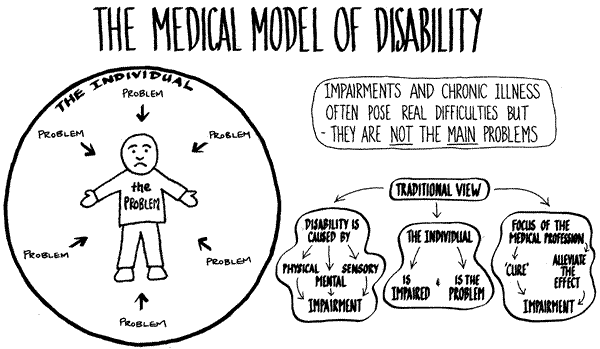
Some examples of a medical model approach might be:
- “a course leader who refuses to produce a hand-out in a larger font for a visually impaired student”(University of Leicester, 2019, The social and medical model of disability, para. 4).
- A staff member refuses to make available a copy of a PowerPoint presentation before a lecture. This creates a barrier to learning for dyslexic students, who are likely to have a slower processing and writing speed (University of Leicester, 2019)
- “a Students’ Union society that organises an event that is not accessible to disabled members”(University of Leicester, 2019, The social and medical model of disability, para. 7).
The socio-political Model of Disability is a model which understands that disability is neutral and a part of the human experience. It highlights “how disabled people can participate in activities on an equal footing with non-disabled people” (University of Leicester, 2019, The social and medical model of disability, para. 9). This model helps to reduce the barriers that people with disabilities may face, even where it involves money and time, as it ultimately wants to ensure that disabled people are not excluded. This social model is based on a more inclusive approach.

Some examples of the socio-political model of disability might be:
- A course leader meets with a visually impaired member of the group, to find out how hand-outs can be adapted so they can read them. (University of Leicester, 2019)
- A staff member makes a PowerPoint presentation available on a Blackboard to all members of the group before a lecture. This allows dyslexic students to look up unfamiliar words and gives them an idea of the structure. (University of Leicester, 2019)
- A Students’ Union society consults with disabled members before organising an event to ensure they cater for their individual needs. (University of Leicester, 2019)
University of Leicester. (2019). Information for Access Ability Tutors: The social and medical model of disability. Retrieved from https://www2.le.ac.uk/offices/accessability/staff/accessabilitytutors/information-for-accessability-tutors/the-social-and-medical-model-of-disability
Classroom activity to ensure that all students are included- Specifically catering for students who are visually impaired:

This activity called “What Shape Am I?” is suitable for students from a foundation level to year 1, particularly when they are learning about shapes where the focus is on learning about the shapes name, angles and sides. This activity caters for all students, especially students who have a disability in which they are visually impaired. This activity allows students to feel the shapes so they can ultimately work out what shape it is through finding out the angles and sides of the given shape. Visually impaired students are able to participate and engage in this classroom activity, as they are simply using the feelings in their fingers to work out what shape it is. Students who are not visually impaired can also be involved in this activity.
This activity ensures that every student is made to feel equal no matter the circumstances, particularly the students who are require special assistance: the visually impaired. This creates a safe and supporting learning environment, where no student is discriminated against, regardless of a disability.
References
World Health Organisation. (2017). 10 facts on disability. Retrieved from https://www.who.int/features/factfiles/disability/en/
Goggin, G. (2005). Disability in Australia: exposing a social apartheid / Gerard Goggin and Christopher Newell. UNSW Press.
Government of Western Australia Department of Communities Disability Services. (1993). Disability sector. Retrieved from http://www.disability.wa.gov.au/understanding-disability1/understanding-disability/what-is-disability/
 Supporting Student Diversity